


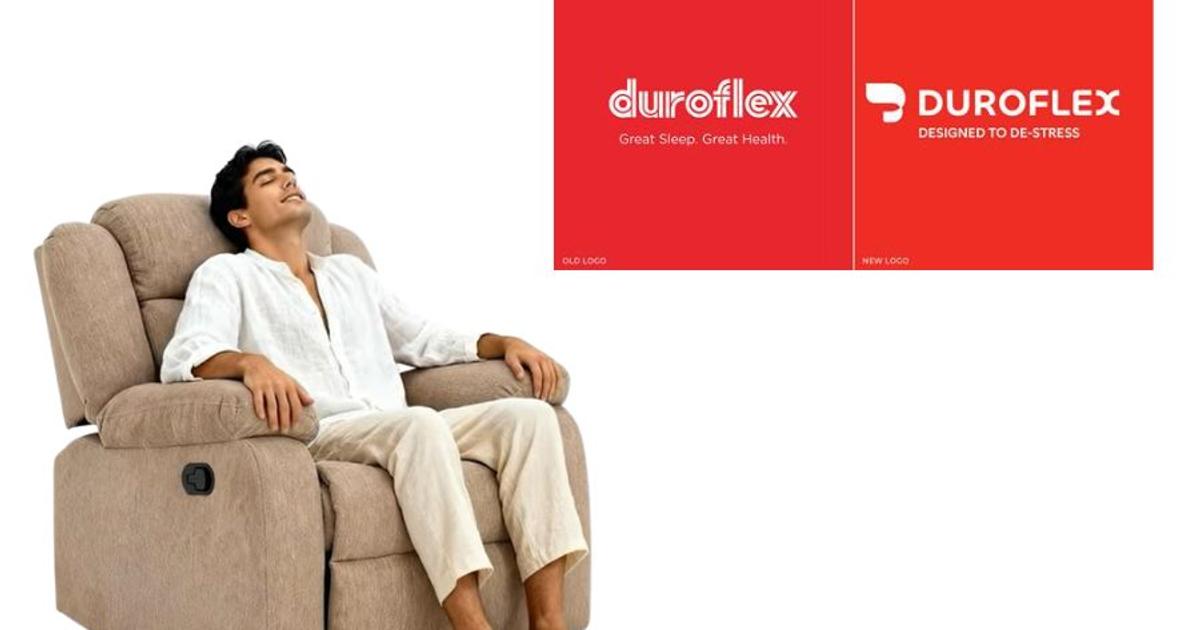
In a category long defined by incremental technology claims and price battles, Duroflex is attempting to shift the strategic centre of gravity. On November 6, 2025, the 60-year-old sleep brand unveiled its new identity and positioning, Designed to De-Stress, signalling a move from a product-led mattress manufacturer to a brand advocating for physical and emotional restoration.
The repositioning arrives at an inflection point for India’s INR 15,000-crore mattress market, as estimated by a Redseer report. Over 60% of it remains unorganised and highly price-sensitive, even as consumer awareness around sleep science and wellness accelerates.
For a company historically rooted in South India, where it claims roughly 20% share in the branded segment, the shift is intended to broaden relevance and redefine category expectations at a time when daily stress has become a national conversation. Whether this purpose-first strategy translates into premiumisation, consumer loyalty, and measurable growth in brand preference now becomes the critical question for marketers and investors alike.
From a commodity to an emotional solution
The repositioning rests heavily on behavioural insight. Duroflex’s leadership argues that sleep-related communication has traditionally focused on marginal comfort upgrades—firmer support, cooling gels, extra layers—rather than the deeper outcome consumers are actually searching for.
Its chief marketing officer Ullas Vijay explains, the strategic pivot is based on extensive consumer research that surfaced a fundamental cultural shift. The repositioning is grounded in extensive consumer research that highlighted a clear shift in how people live today.


Duroflex’s chief marketing officer, Ullas Vijay.
“Our consumers are constantly on the move, balancing work, commutes, responsibilities, and the pressure to keep up. This relentless pace has turned stress from an occasional concern into something they experience daily. It shows up in the body as knots, stiffness, joint pains, fatigue, and an overall sense of restlessness that affects both productivity and physical wellbeing,” Vijay told Campaign.
Duroflex identified a gap in how the market addresses the root problem of stress, which is now a lived reality for millions of Indians. Deep, restorative sleep has become essential to counter its effects.
“Our purpose-led approach addresses this gap by creating awareness around the role of sleep and the right sleep solutions in managing everyday strain… allowing people to wake up feeling genuinely restored, both physically and mentally,” Vijay added.
This psychological reframing from product efficacy to emotional outcome informs the refreshed visual identity. Describing the new language, he said that the new identity is built on continuity and renewal, expressing the idea of a ‘stress-free, motivating reset’. It retains the recognisability of Duroflex’s heritage red while shifting to a softer, more uplifting tone that conveys energy and optimism.
The focus on universality was essential for a brand that spans metro millennials and Tier-2 homemakers. To resonate across segments, the company identified a universal truth that transcends demographics—stress is inevitable and exists for everyone. Vijay argues that stress equality, rather than demographic segmentation, makes the narrative scalable without diluting legacy credibility.
IPO timing and business refresh
The launch of Designed to De-Stress coincides with the company’s Draft Red Herring Prospectus filing. The alignment raises the obvious question—whether the brand refresh doubles as a signal of transformation aimed as much at investors as consumers.
With the prospectus outlining an INR 183.6-crore fresh issue earmarked for expansion of company-owned, company-operated (COCO) stores and marketing visibility, the interplay between capital strategy and brand ambition becomes difficult to ignore.
Sridhar Balakrishnan, CEO, addresses the timing directly. “The brand refresh and the DRHP filing are both milestones in our ongoing transformation, each aligned with our long-term strategy. Over the years, Duroflex has moved from being known primarily as a trusted mattress maker to becoming a holistic sleep and comfort solutions brand,” he told Campaign.

Sridhar Balakrishnan, CEO, Duroflex.
He frames the shift as part of a broader societal need; sleep is a single part of the recovery cycle, but rest is broader. This shift allows Duroflex to support consumers across their entire rest journey, not just at night.
When asked about distribution strategy beyond the brand identity exercise, Balakrishnan emphasises profitability discipline rather than aggressive discounting. Over the past few years, the company has scaled this success nationwide through a balanced multi-channel model.
“Our network today includes 73 company-owned stores and over 5,000 retail touchpoints. Our pricing and distribution decisions are driven by long-term consumer trust and brand equity rather than short-term volume expansion,” he added.
The approach suggests a deliberate refusal to chase scale at the cost of margin, which is a notable stance in a market dominated by deeply-discounted, unorganised players and newer D2C challengers.
Premium pricing in an unorganised market
Converting unbranded mattress buyers—accustomed to INR 8,000 to INR 10,000 neighbourhood store purchases—into premium seekers demands more than advertising. The company is reframing purchase decisions around health rather than price comparison.
Vijay said, “We’ve reframed the purchase decision from price to value. We help consumers understand the tangible difference that science-backed design and tested quality bring to their daily wellbeing.”
He argues that awareness around fatigue, productivity loss and body stress is starting to create willingness to pay. Whether that recognition translates into sustained premiumisation remains dependent on category education and measurable perception shifts—data the company has yet to publicly quantify.
For a brand repositioning itself around emotional restoration, the balance between storytelling and ROI-driven performance marketing emerged as a central consideration.
Vijay rejects the dichotomy. For Duroflex, storytelling and performance marketing are not opposing forces, they complement each other. “We are investing in content ecosystems that educate and engage, supported by robust performance channels that ensure discoverability and measurable impact,” Vijay explained.

The strategy reflects a broader trend across consumer durables: move upstream to build cultural authority, while ensuring digital efficiency to convert intent. This layered narrative also drives the brand’s research approach.
On integrating neuroscience and sensory testing, Vijay said, “Our creative strategy is informed by behavioural insights around stress triggers and recovery needs. Rather than using clinical or overly technical language, we have crafted a narrative that resonates emotionally while being scientifically grounded.”
Building a sleep-wellness ecosystem
Asked about expanding beyond mattresses into sleep and wellness partnerships, Balakrishnan said, “We are steadily integrating technology and design thinking into our offerings, whether through smart ergonomics, advanced materials, or sensory comfort testing… That will be our guiding light as we deepen our expertise in rest and explore partnerships and innovations within the wider sleep and wellness ecosystem.”
It is a cautious but intentional articulation, avoiding hype while signalling adjacency moves in health-tech, lifestyle and potentially digital wellness platforms. Duroflex’s strategic pivot arrives as India’s wellness economy matures, AI accelerates personal-health diagnostics and younger consumers demonstrate lower loyalty but higher willingness to experiment. At the same time, premium mattress brands face intensifying competition from D2C insurgents and global players entering India’s retail and e-commerce ecosystem.
If Designed to De-Stress succeeds, Duroflex could recast the category narrative away from inches and layers toward recovery and well-being. If it doesn’t, the repositioning may struggle to bridge the gap between emotional promise and transactional market realities.
For now, the company is betting that stress, and the desire to escape it, is the unifying cultural currency of the decade. In a marketplace where most players still sell materials and specifications, the contest may now shift to who sells meaning most convincingly.
Whether that creates enduring competitive advantage, or simply triggers the next wave of sleep-economy messaging, will become evident soon enough—especially for an industry where the difference between being chosen and forgotten is decided in a moment when consumers are half-asleep.
link