Seattle DJC.com local business news and data – Architecture & Engineering

October 16, 2024
Designing healthier and greener schoolyards in LA
By KATE FORESTER, LILY SCHREDER, STACY LUELL
Herrera
To address the need for greener, more engaging educational spaces within Los Angeles communities, the Council for Watershed Health and Los Angeles Unified School District (LAUSD) have begun implementing a schoolyard redesign project funded by CAL FIRE’s Green Schoolyards Program. The grant program provides funding for green schoolyard design at selected schools.
The schoolyard redesign project is part of a planning grant that includes preliminary “shovel ready” designs for eight schools. Community engagement and design is being led by four community-based organizations and three different design teams. Herrera has taken a lead role in this transformative endeavor and is responsible for designing green schoolyards for three of the eight LAUSD schools selected for conceptual redesign.
Herrera’s team is led by Kate Forester, who is technical lead on the project and overall team lead, Annaliese Chapa is leading community engagement and schematic design phases, and Stacy Vayanos is leading subsequent design phases. Forester is based in Davis, California, Chapa is based in the firm’s Portland office, and Vayanos is based in the Seattle office. Herrera’s role involves comprehensive design leadership, coordination with community-based organizations and technical design teams, and active engagement with the school communities. The resulting designs will be both environmentally sustainable and reflective of the unique needs of each school community, with the intention of helping LAUSD lay the groundwork for similar projects in the future.
The design project follows these steps at each school:
1. School community engagement
2. Development of concept alternatives
3. Schematic development of preferred concept
4. Design development for grant funding
The project is currently at step three.
ENGAGEMENT PROCESS
A significant requirement of the CAL FIRE grant is to maximize tree canopy cover, immediate heat respite, asphalt removal, and habitat creation.
The design process began with the essential work of community-based organizations (CBOs). Each school was paired with a CBO and a design team as partners in creating a vision for each campus. The CBOs are active within the school communities and guided the processes for engagement.
Our team goal was to have design outcomes represent the ideas and visions of the communities who may inherit them. Project teams typically received input from principals, faculty, operations and maintenance staff, students, and families. Engagement activities started by defining what types of design interventions qualified for grant support followed by listening and brainstorming activities where the community defined what school greening ideally looks like for them and what vision they have for their campus.
One of our partners, Ms. Martinez from Nature for All, has been meeting parents, teachers, and students to explain the design project and get community input through interactive presentations, surveys, and live conversations about their visions for the school. Engagement events resulted in valuable feedback that shaped the development of design alternatives.
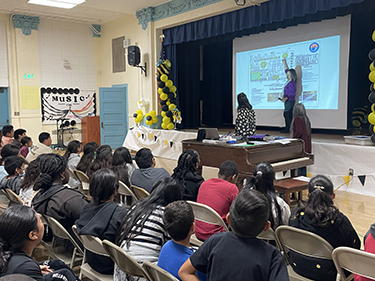
Teachers, students and their families expressed desire for tree shade, native and edible plantings, nature and sensory play areas, outdoor classrooms, and places to lounge and relax. On one campus, many teachers identified their favorite place as the shaded space beneath the wide canopy of a 20-year-old Coast Live Oak, fondly named the Wisdom Tree.
Outdoor education priorities for the schools included physical education, outdoor reading spaces, nature walks, exploration opportunities, and more. An interesting result of student input was that just as many children were looking for quiet places as there were students who were seeking active play areas. Designs for each campus aimed to incorporate access to all these opportunities across grade levels.
An example of student-centered engagement included activities like providing classes with a map and asking them to identify their favorite and least favorite place, as well as the hottest and coolest places on campus. Students also provided drawings of what they wanted to see on campus and were given opportunities to talk with the team about their school. Many students drew features that are not eligible for grant funding, like tree houses, creative playgrounds, fantastic rocket ships, new soccer fields and a large swimming pool. However, they also drew lots of big trees, beautiful flowers, soaring birds, and many colorful butterflies and insects. The kids were very happy to see their own drawings presented on the screen during the follow-up presentations.
DESIGN PROCESS
Once the initial School Community Engagement was completed, Herrera took ideas from the community’s input and turned it into three different options to present back to the students and teaching staff at each school for another round of input. All options provided more tree canopy with shaded natural play areas, habitat gardens for exploration, and outdoor classrooms in different locations and configurations. These options were vetted by each school and one preferred option was selected.
Kate Forester remarks how this community-focused process is important, “The designs really come from the community. We, the designers, are of service to them. We aren’t coming in as high-level experts telling them what they need. It’s the kids, parents and teacher who are defining their space.”
This project was designed to be collaborative from start to finish, with the goal of reducing heat on playgrounds and enriching the outdoor education experiences for LAUSD students. As designs move forward, the team hopes that designs will be completed and approved for construction, making these visions a reality.
Herrera is an engineering and scientific consulting firm that specializes in sustainable development, water, and restoration, with offices in Seattle; Bellingham; Portland, Oregon; Missoula, Montana; and Caspar, Wyoming.
Kate Forester is a principal landscape architect at Herrera with 25 years of experience in natural resource planning and design for sustainable public uses. Lily Schreder is a marketing specialist at Herrera with a background in marketing and environmental studies. Stacy Luell is a professional engineer at Herrera with 13 years of experience in stormwater management and compliance.
link