Sustainable Paris Olympics vs. health concerns over plastic bottles: effective marketing communications to promote the use of canned beverages
Results
As presented in Fig. 5, in the control group (Group 1), the percentage of people who believed the product was attractive was roughly equal between cans (33.6%) and plastic bottles (32.4%). The chi-square test results were p = 0.959 and OR = 1.060 (95% confidence interval [CI]: 0.572–1.968), and the null hypothesis was not rejected. In other words, there was no significant difference in consumer responses to cans and plastic bottles for coffee.

Chi-square test based on the results of the randomized controlled trial.
In Group 2, which was presented with the Olympics stimulus, the percentage of people who felt that the product was attractive was higher for cans (44.2%) than for plastic bottles (25.7%), with cans receiving a higher score. The chi-square test results were p = 0.010, OR = 2.276 (1.200–4.378), leading us to reject the null hypothesis and detect a significant difference. This means that when Olympic stimuli are presented, people are 2.276 times more likely to find a can more attractive than a plastic bottle. Thus, H1 was supported.
The participants of Group 3 were exposed to the microplastic stimulus; the proportions of people in this group who sensed the product’s appeal in cans (31.6%) versus plastic bottles (34.0%) were roughly equal. The results of the chi-square test were p = 0.834, OR = 0.898 (0.472–1.705), and the null hypothesis was not rejected. Therefore, H2 was not supported.
Table 5 shows the results of multiple regression analysis of the impact on the attractiveness of canned coffee products. The model formula in Table 1 is as follows:
$$\begin{array}{l}{Attractiveness}=-0.250+0.080* {PC}-0.049* {Age}+0.075* {Green\; purchase\; behavior}\\\qquad\qquad\qquad\qquad+\,0.045* {Sweetness\; of\; milk}+0.184* {Environmental\; friendliness}\end{array}$$
The results of the base model 1 show that green purchasing behavior and the evaluation of a product’s environmental friendliness are significant at the 5% level. However, consumer age and sweetness of milk have no effect. Model 2, which added the interaction between Olympics and personal innovativeness to Model 1, did not detect a significant effect in the interaction term. Model 3, which added the interaction between microplastics and personal innovativeness to Model 1, detected a significant negative effect in the interaction term. To examine the effects in more detail, we performed a simple slope analysis based on Models 2 and 3. As depicted in Table 6 and Fig. 6, when personal innovativeness is high (mean + 1 standard deviation [SD]), the Olympics have a positive effect on attractiveness (β = 0.156, p = 0.041). When personal innovativeness is low (mean −1 SD), the effect of the Olympics is not significant (β = 0.000, p = 0.997). This finding suggests that the innovative, forward-looking policies of the 2024 Paris Olympics are likely to influence consumers with high levels of personal innovativeness. Note that, as shown in Model 2 of Table 5, Olympics × Personal innovativeness is not significant. This is performed as an exploratory analysis. When personal innovativeness is high (mean +1 SD), microplastics have a negative effect on attractiveness (β = −0.209, p = 0.008). When personal innovativeness is low (mean −1 SD), the effect of microplastics is not significant (β = 0.030, p = 0.699).
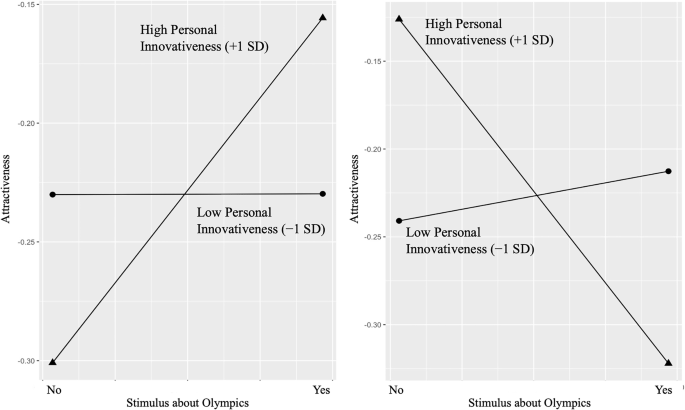
Results of the simple slope analysis.
Therefore, the higher one’s personal innovativeness, the more the Olympic policy banning single-use plastic bottles significantly increases the appeal of canned drinks to consumers than information about research that raises health concerns regarding the microplastics contained in plastic bottles, thus supporting H3. Furthermore, all models’ variance inflation factors were low, confirming no multicollinearity.
Discussion
Contrary to prior assumptions, concerns about microplastics had little effect on the attractiveness of the cans. This is because the adverse health effects of microplastics remain unclear (Qian et al., 2024). As health concerns regarding microplastics are known (Kumar et al., 2022; Li et al., 2021), the number of microplastics in plastic bottles may not be news to consumers. Another reason is that some products are sold only in plastic bottles, and it is very difficult or impossible for consumers to change them to cans through their own efforts. This is an external factor that consumers cannot change, and it may hinder their positive awareness and behavior. Furthermore, consumers with high personal innovativeness perceived a decrease in the attractiveness of cans when they viewed information on microplastics. This is because of the influence of rationality, another aspect of innovative consumers. Now that the Internet has democratized information, innovative consumers use social media to search for information about new trends and technologies, verify authenticity, and make rational decisions (Al-Jundi et al., 2019). In particular, the spread of fake news has become a problem. The more innovative people are, the more sensitive they are to authenticity. For example, when COVID-19 spread, governments and companies worldwide struggled to disseminate accurate information by competing with scientific-sounding misinformation, and many consumers became aware of the strong influence of fake news (Loomba et al., 2021). Hence, in Japan, the Japan Fact-check Center was launched with financial support from Google and Yahoo to monitor fake news (Yomiuri Shimbun, 2022). Innovative people are aware of these social trends and have responded to avoid being swayed by unclear information on microplastics.
Theoretical contributions
Brand conscience can not only change social consciousness but also generate significant business growth because today’s consumers want to support brands that are sincere about social and environmental responsibility (Beitelspacher and Getchell, 2023). Against this background, conscientious brands that integrate competitive products with social problem-solving are in demand (Guzmán et al., 2024; Markovic et al., 2023). Therefore, companies need to make sincere decisions for the sake of a better world in the long term, even if it means risking lower sales in the short term; hence, it is a misconception that a profit-making business is incompatible with altruistic interests (Beitelspacher and Getchell, 2023). As a representative example of what such brands need to do, this study focuses on the shift from plastic bottles to sustainable containers. In this context, this study makes two primary theoretical contributions.
Plastic pollution is recognized as a serious environmental problem and has been actively discussed in scientific papers (Chen et al., 2021; Forrest et al., 2019; Jiao et al., 2024; MacLeod et al., 2021; Pilapitiya and Ratnayake, 2024; Shen et al., 2020). As a solution, the benefits of cans as an alternative material to plastic bottles have been advocated (Camaratta et al., 2020; Deshwal and Panjagari, 2020; Mordor Intelligence, 2023; Schwertheim, 2022; Simon et al., (2016); Tabereaux and Peterson, 2024). However, it is not easy for consumers to give up plastic bottles, which they have become accustomed to for their convenience (Kurutz, 2019). In the absence of scientific knowledge to solve this problem, the present study fills the gap. To address plastic pollution, we introduced two novel approaches—an Olympic environmental policy and information about health concerns regarding microplastics—as marketing communication strategies to promote changes in consumer attitudes. As consumer indifference is a major problem in tackling plastic pollution, a new marketing strategy to overcome this situation is important.
Second, this study extends the Olympic effects literature (Chong and Hui, 2013; Kassens-Noor and Fukushige, 2018; Long et al., 2018; Panagiotopoulou, 2012; Simón, 2014; Vierhaus, 2019) to changes in consumer attitudes towards environmental policies. The Olympic Games are one of the most influential mega-events in the world (Tu et al., 2023). Countries and governments have taken advantage of the influence of the Olympics and used it as a means to improve the image of their countries and regions (Dubinsky, 2019). Existing literature has focused on the image-related effects of the Olympics in terms of the host country’s image of advanced industry and cultural history (Kassens-Noor and Fukushige, 2018; Panagiotopoulou, 2012). As a result of the image being strengthened through the event, people’s attitudes toward the country become more positive, and tourists from all over the world visit the country (Chong and Hui, 2013; Vierhaus, 2019). For example, Tokyo 2020 aimed to showcase Japan’s recovery from the 2011 Great East Japan Earthquake and the Fukushima Daiichi nuclear power plant accident, and to promote Japan’s traditional culture and innovative technology (Dubinsky, 2025). It is estimated that as a result of the Olympics, approximately 390 million people in 13 countries and regions became interested in visiting Japan (Japan National Tourism Organization, 2022). In fact, the number of foreign tourists in 2019, before the Games, was 31,882,049, but by 2024, after the Games and the COVID-19 pandemic, it had risen to a record high of 36,870,148 (JTB Tourism Research & Consulting, 2025). The present study applied this theoretical knowledge and extended the image owner to plastic bottles (or cans) and the image to environmental concerns. As a result, people’s perceptions of plastic bottles have changed. The effect of this event will likely be due in part to the influence of the Olympic Games themselves, as well as the fact that the host country is France. France is a leading country in sustainability efforts (Sustainable Development Report, 2025). This is the likely reason that the country’s promotion of eliminating plastic bottles on the big stage of the Olympics has impressed upon people the change to a new era. This effect is similar to the brand endorsement effect of athletes. Athletes are highly persuasive because their opinions are more likely to be viewed as genuine, as they are highly successful people (Malik and Guptha, 2014). In the context of this study, the policy is likely to be particularly persuasive to people because it is promoted by France, which has been seriously working on environmental measures since before the Olympics.
The cost of hosting the Olympics has increased owing to rising labor and material costs, and the significance of hosting the Olympics has been questioned (Flyvbjerg et al., 2021; Kato, 2021; Khraiche and Alakshendra, 2021; Müller et al., 2022). However, as shown in this study, expanding the scope of the Olympic effects to include public perceptions and attitudes toward environmental policy could once again strengthen the significance of this mega-event. This is because implementing environmental policies requires huge costs. As awareness of the importance of conscientious brands is growing, it is significant that we demonstrate a concrete marketing strategy for the specific theme of eliminating plastic bottles.
Practical implications
This study has two practical implications. First, governments and companies promoting environmental policies should consider the Olympics as a potential trigger of changes in consumer attitudes. Green business management has become increasingly important for marketing strategists (D’Souza et al., 2015). Although many organizations are working on green transformation, this process is time-consuming (Akatsu and Van Wassenhove, 2024). Symbolic examples are effective in changing people’s attitudes.
Second, countries and local governments considering hosting the Olympics should not limit the scope of Olympic effects to their impact on finances and urban development. As this study shows, incorporating the perspective of changing people’s attitudes can help shape public opinion on policies that are difficult to implement. Notably, we detected an impact of the environmental policy analyzed in this study on changing consumer attitudes. This result is significant in that attracting the Olympics through fiscal spending improves social welfare through changes in consumer behavior. If the Olympics can generate broader social benefits, it could potentially offset the financial burden it imposes on countries. Furthermore, because the Olympics are a globally iconic event, the positive social benefits shown in this study could have a ripple effect around the world.
link