USDA Shuts Down Regional Food Business Centers Created Under Biden Administration
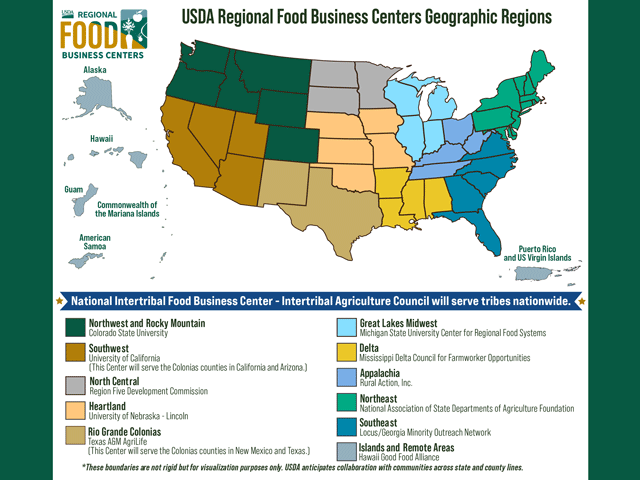
The RFBCs were set up to be led by independent groups or universities. In Appalachia, the group, Rural Action Inc., covered all of four states and parts of three others. The group was expected to receive $16.6 million spread out through 2027 for grants and assistance.
Other centers were led by Michigan State University, the University of Nebraska, Colorado State University, the University of California, Texas A&M AgriLife, the Mississippi Delta Council for Farmworker Opportunities, the Georgia Minority Outreach Network, the Hawaii Good Food Alliance, the Region Five Development Commission, the National Association of State Directors of Agriculture (NASDA) Foundation, and the Intertribal Agriculture Council.
Under the RFBC, USDA created “Business Builder” grants that ranged from $1,000 and $100,000 per business. The grants were set up to buy equipment for processing, packaging or cold storage, or other efforts such as business planning and marketing. The grants had certain restrictions such as they could not be used for land or buildings. Each of the regional business centers had discretion to create their own programs and grant guidance.
USDA announced last December it had awarded $7.8 million in Business Builder grants in 2024 but had committed to award $112 million in such grants by December 2027 nationally. The largest block of grants was expected to flow through the National Intertribal Food Business Center, which had $25 million.
In its news release terminating the centers, USDA stated only eight of the 12 RFBCs had selected or awarded Business Builder grants but they would be honored.
“The Biden Administration created multiple, massive programs without any long-term way to finance them. This is not sustainable for farmers who rely on these programs, and it flies in the face of Congressional intent,” Rollins said. “USDA will honor existing commitments for over 450 grants to farmers and food businesses to ensure planning decisions on the farm can continue as normal, however stakeholders should not plan on this program continuing. Any remaining funds will be repurposed to better support American agriculture.”
A USDA report last October highlighting the RFBCs cited they had helped 287 businesses increase revenue and provided more than 2,800 individuals with technical assistance in their first year, along with helping leverage more than $4.1 million in funds in different regions. The centers were just starting to hold events and issue grant awards.
“USDA will honor current and pending commitments to producers and food businesses through the Business Builder subaward program.”
USDA added in its news release, “Due to the broad scope of the program, and a long process of setting up partnerships and conducting work planning, a relatively small number of those Business Builder grants have been awarded to date. RFBC’s that have executed or announced Business Builder subawards will have the option to continue managing those existing commitments through May 2026.”
Centers that have not yet made Business Builder commitments will be terminated; these include the Great Lakes Midwest RFBC (Michigan State University), Southeast RFBC (Georgia Minority Outreach Network), Delta RFBC (Mississippi Delta Council for Farmworker Opportunities), and Islands and Remote Areas RFBC (Hawaii Good Food Alliance).
Closing the centers and ending their funding comes just two months after Rollins released the Trump administration’s “Farmers First” agenda, which declared more support for small farmers, “which are the heart of our communities and our nation.” The plan highlighted the importance of helping small farmers navigate USDA programs, including Rural Development loans. USDA also stressed the importance of ensuring small farmers have reliable access to credit, markets and infrastructure.
The National Sustainable Agriculture Coalition (NSAC) criticized USDA for shutting down the food business centers and pointed to the Trump administration’s recent roll out of the Farmers First plan.
“About a month after the Trump administration released the Farmers First agenda, the U.S. Department of Agriculture (USDA) has made yet another decision to prematurely end multi-year agreements that are effectively serving the small family farms the administration claims to be the focus of their agenda,” said Hannah Quigley, an NSAC policy specialist. “The recent termination of agreements with 12 Regional Food Business Centers comes as another blow to rural communities, which benefit greatly from USDA business development resources. The president’s budget has also proposed eliminating funding for numerous rural business development programs.”
Also see, “Groups Weigh Options After USDA Rescinds $1 Billion in Regional Conservation Grants,”
Chris Clayton can be reached at [email protected]
Follow him on social platform X @ChrisClaytonDTN
(c) Copyright 2025 DTN, LLC. All rights reserved.
link